

The Best Portable SSD

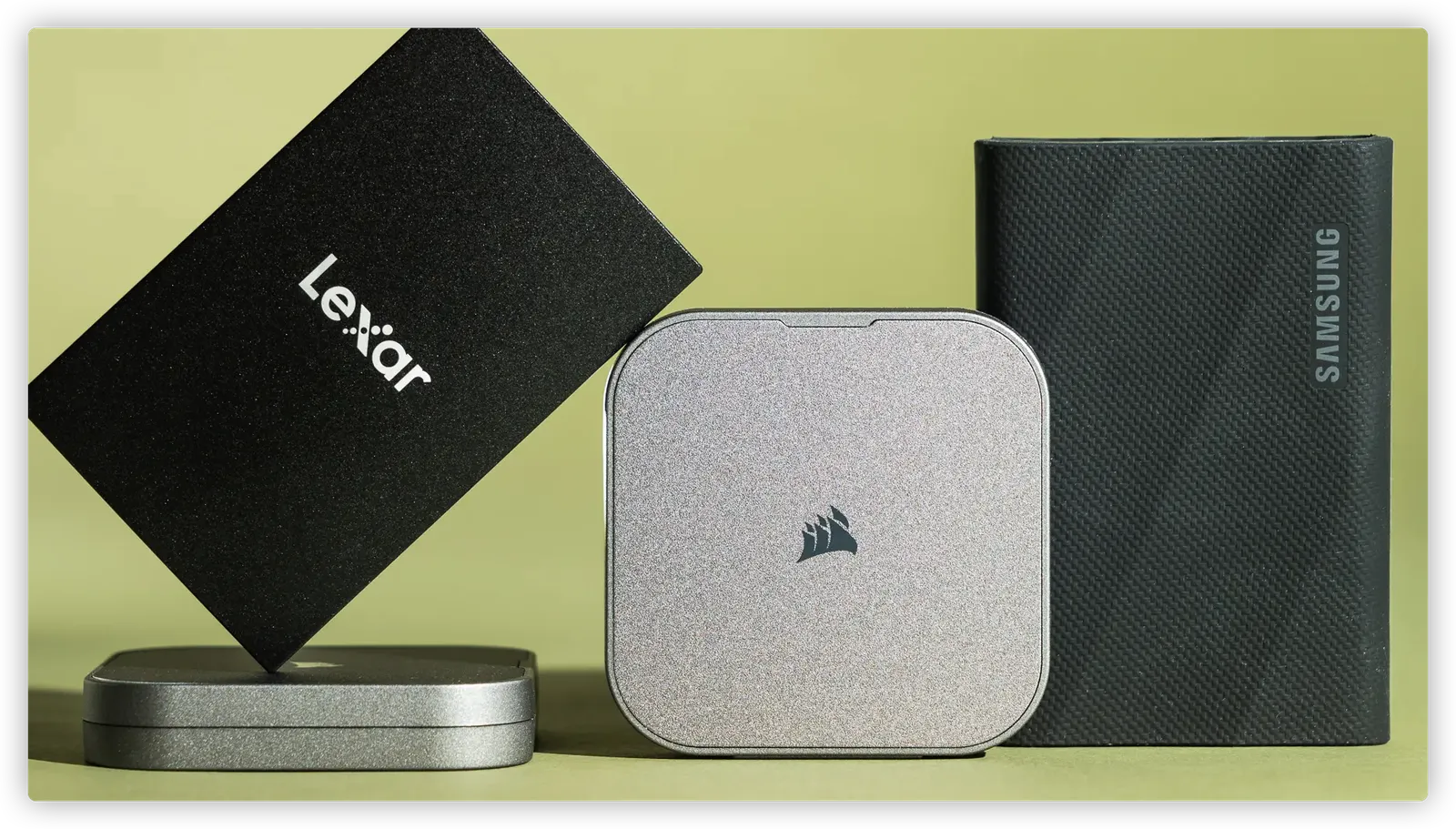
A black Lexar SSD is tilted on a gray base next to a square, silver Corsair SSD. To the right, a black, textured Samsung SSD stands upright, all against a pale green background.
If you regularly need to move large files between computers or want a travel backup for your laptop, get a speedy portable SSD, or solid-state drive. They’re more expensive than portable hard drives, but because they have no moving parts, they’re inherently faster and more durable. After researching and testing 24 new portable SSDs, we found that the Corsair EX400U (1 TB) offers the best mix of affordability, speed, and durability for most people.
Top pick

This compact, MagSafe-compatible portable SSD delivers speedy performance and can easily snap to a phone for extra storage.
The Corsair EX400U (1 TB) is the first USB4 drive we’ve tested that has the speed, price, and features to be worthy of top-pick status. Although it costs a bit more than USB 3.2 drives with the same capacity, it delivers almost triple the speed, as long as you plug the drive into a USB4 or Thunderbolt 4 port (found on most recent laptops). If you don’t need USB4, our budget pick is a better choice.
Upgrade pick
Though the 4 TB version is more expensive than our top pick, it offers extra space for larger files such as game installers, multiple years’ worth of backups, or raw videos and photos.
Larger-capacity SSDs like the 4 TB Corsair EX400U (4 TB) are worth the investment if you regularly store large files such as 120 GB game installers or multi-gig 4K/8K video files and need immediate access to them. Like our top pick, the 4 TB version of the EX400U strikes an excellent balance of price, capacity, and speed.
Budget pick
The metal Lexar SL500 isn’t as speedy as our top pick, but it offers solid performance and the same amount of storage.
The Lexar SL500 (1 TB) is a sturdy, reliable storage drive that costs far less than our top pick. It isn’t as fast, but using it is speedier than working with cloud storage, using external hard drives, or copying over Wi-Fi.
Advertisement
Why you should trust us
I’m a writer who has covered portable SSDs, hard drives, and other computer hardware for Wirecutter since 2018. In a previous life, I was an IT technician and manager. I have been testing and writing about PCs and networking for over 20 years, reviewing thousands of devices in that time. I’ve evaluated a multitude of storage devices since the early 2000s, from portable and desktop hard drives to SSDs to NAS devices to USB flash drives to microSD cards.
For this guide:
- I evaluated each portable SSD’s price compared with its peers, as well as its physical construction, its ancillary features, and how it fits the needs we set out for this guide.
- Over the years I’ve run standardized tests on more than 100 portable SSDs to evaluate their durability, and I’ve assessed their availability and warranties.
- Like all Wirecutter journalists, I review and test products with complete editorial independence. I’m never made aware of any business implications of my editorial recommendations. Read more about our editorial standards.
- In accordance with Wirecutter standards, I return or donate all products I’ve tested once my assessment of them is complete, which may involve longer-term testing by my colleagues and me. I never hang on to “freebies” once testing is done.
Who this is for
Portable solid-state drives are great for travelers and for people who frequently transfer large amounts of data between computers or phones. Since SSDs have no moving parts, they can handle the bumps during your commute or other journeys. If you need a drive just to back up your data at home, and you aren’t worried about having the fastest transfer speeds, a portable hard drive is much less expensive, though it’s also slower, larger, and less durable.
Portable SSDs are orders of magnitude faster at transferring files than portable hard drives or desktop external drives. They’re also more secure and much more compact and durable, and they run cooler on less power. They cost more, however.
If you spend most of your time working at the same desk or need more than 4 TB of storage, get an external desktop hard drive. A desktop hard drive is faster than a portable hard drive and much less expensive than a portable SSD for a similar amount of storage, but it’s bulky, so you shouldn’t plan to travel with it.
Advertisement
How we picked
Though a portable SSD looks like a relatively simple device, we took a number of factors into account when we decided which models to recommend:
- Reliability and toughness: Since portable SSDs lack moving parts, they are less susceptible than mechanical drives to data loss or failure when dropped or subjected to vibration. A portable SSD should be sturdily built.
- Endurance: Flash-memory cells can be written to only so many times before wearing out. You would have to write hundreds of terabytes of data to even begin to wear out most SSDs, though, and few people approach that limit. Since SSD manufacturers don’t report durability ratings for external drives (only for internal models), we keep an eye on buyer reviews for reliability information. For example, we note when owners mention that their SSDs run hot; too much heat during operation can shorten the drive’s life or indicate that the drive is defective.
- Drive speed: We tested both sequential and random speeds. Although fast sequential speeds are important for transferring and backing up large blocks of data such as video files and game installers to your drive, quick random speeds are essential if you run programs or games directly off your portable SSD.
- Connection type: For this guide we primarily considered portable SSDs with USB-C connectors, which have replaced older, slower USB Type-A ports on thinner laptops. Some of the drives come with either a Type-A adapter or a separate cable to ensure compatibility with the desktop PCs, laptops, gaming consoles, and tablets you may have around your home.
- Price: More expensive portable SSDs can offer faster write and read speeds, but you shouldn’t overpay for extra speed or other features that you may not even notice. For instance, our 1 TB top pick has speeds exceeding 3,000 MB/s — it’s 200% faster than our budget pick, the 1 TB Lexar SL500. But if you’re just using your drive as an automatic backup device, you can save a chunk of change by buying the cheaper SL500.
- Capacity: Currently, an SSD with a capacity of 1 TB represents the best mix of affordability, space, and speed. Drives with capacities of 4 TB tend to be about as cost-effective. Our picks for the best laptops have 256 GB to 1 TB of drive space, so a 1 TB to 4 TB portable SSD has enough capacity to back up such laptops with room to spare.
- Size and weight: A portable SSD should be light and compact. Many are roughly the size of a stack of sticky notes (or even smaller).
- Software: Backup software is a nice addition to a portable SSD, but it isn’t essential. You can find plenty of backup-service alternatives online.
- Indicator light: Some drives have an LED indicator that lights up when the drive is connected to your device, and although this indicator is not a requirement, we found it useful.
- Warranty and customer service: Three-year warranties are standard among portable solid-state drives, though a few come with five-year warranties. Strong customer service is also valuable when something goes wrong.

Four portable SSDs of different sizes and shapes arranged side by side next to a sticky note for comparison.
To find worthy contenders, we investigated the most popular portable solid-state drives on Amazon, and we checked online reviews on tech sites such as AnandTech, Dong Knows Tech, and PCMag. We also scoured the websites of well-known external-SSD manufacturers such as LaCie, Samsung, SanDisk, and Western Digital.
Advertisement
How we tested
We used synthetic benchmarking software, CrystalDiskMark, to test each drive’s sequential and random speeds. We ran all of our tests on a Dell Latitude laptop; its NVMe PCIe solid-state drive and USB4 port were fast enough to avoid bottlenecking the drives we tested. We also explored each drive’s included software, if it had any, and we checked build quality to confirm that there were no obvious red flags.
Top pick: Corsair EX400U (1 TB)

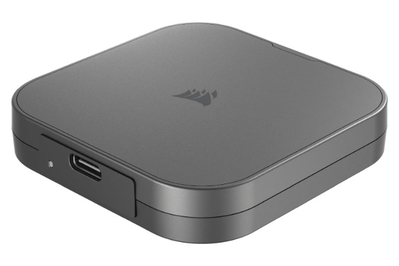
A square Corsair EX400U portable SSD with rounded corners and a silver, textured finish.
Top pick
This compact, MagSafe-compatible portable SSD delivers speedy performance and can easily snap to a phone for extra storage.
| Capacity: | 1 TB | Physical size: | 2.6 by 2.6 by 0.47 inches |
|---|---|---|---|
| USB interface: | USB4 | Warranty: | three years |
The Corsair EX400U (1 TB) is reliable, fast, and reasonably priced, and it’s compact enough to carry around in your pants pocket. The EX400U has a single USB-C port that supports transfer speeds of up to 40 Gbps (USB4), far outpacing older, USB 3.2 drives. The drive’s built-in magnetic ring lets you clip it to the back of any MagSafe-compatible iPhone (an iPhone 12 or newer) or any phone case with a magnetic ring.
CrystalDiskMark file transfers in MB/s
| Sequential read (Q8T1) | Sequential write (Q8T1) | Random read (QT1T1) | Random write (QT1T1) | |
|---|---|---|---|---|
| Corsair EX400U (1 TB) Top pick | 3,272.95 | 2,936.91 | 59.07 | 127.53 |
| Corsair EX400U (4 TB) Upgrade pick | 3,189.53 | 3,014.48 | 59.35 | 114.48 |
| Lexar SL500 (1 TB) Budget pick | 1,059.97 | 1,036.1 | 40.14 | 79.39 |
| Samsung T9 (4 TB) Worth considering | 1,066.36 | 1,023.1 | 20.66 | 80.43 |
| SanDisk Extreme Pro with USB4 (4 TB) | 3,237.05 | 3,059.03 | 64.09 | 13.91 |
| SK Hynix Beetle S31 (1 TB) | 1,058.95 | 1,046.36 | 40.46 | 79.6 |
| Samsung T7 Shield (1 TB) | 1,060.12 | 996.58 | 29.62 | 80.89 |
| Samsung T7 Shield (4 TB) | 1,059.64 | 1,030.37 | 29.08 | 81.24 |
| Kingston XS1000 (1 TB) | 1,057.32 | 980.15 | 28.49 | 78.32 |
All speeds are expressed in megabytes per second.
The EX400U is one of the fastest drives we’ve tested. The Corsair EX400U is one of the first USB4 drives we’ve tested, and we like where the technology is headed. USB4 is capable of transfers at speeds of at least 20 Gbps (gigabits per second), a significant improvement over the 10 Gbps you can expect from USB 3.2 Gen 2 SSDs. It can copy large files simultaneously at 3.2 GB per second — this drive took just 4 to 5 seconds to transfer our 15 GB folder of files, in contrast to our old top pick, a USB 3.2 drive that took 25 seconds to transfer the folder. As long as you have the EX400U connected to a USB4 or Thunderbolt 4 port, it will be just as speedy. USB4 uses the same USB-C physical ports as USB 3.2 and USB 3.2 Gen2, but with newer cables to handle the increased speeds. You can find these ports on most laptops and desktop PCs and Macs purchased in the past few years, but check your computer’s technical specs to be sure.
Compared with an external hard drive, the Corsair EX400U is remarkably speedy. On the CrystalDiskMark benchmark measuring sequential read and write speeds (transferring large files one after another, similar to when you’re backing up your laptop’s main drive or transferring video files), our top external hard drive pick managed read speeds of 129 MB/s and write speeds of 119 MB/s, while the EX400U zipped through the same test at speeds of 3,273 MB/s and 2,937 MB/s, respectively. The EX400U is more than fast enough to justify the expense.
It’s an excellent choice for expanding your laptop’s or game console’s storage. On a different subset of the CrystalDiskMark test that is designed to simulate the demands of tasks such as transferring multiple small files or running programs off the external SSD, the EX400U was also an excellent performer. In these tests, the EX400U had random read and write speeds at the top of the range (59 MB/s and 128 MB/s, respectively), whereas our former pick, the Samsung T7 Shield, was much slower (30 MB/s read and 81 MB/s write). Using a drive with twice the write speed has a significant impact on day-to-day use; if, for example, you use it to back up seldomly played games off the internal SSD in your Xbox or PlayStation to free up the space for new games and then reinstall them later on demand, it’s a lot faster and more convenient than reinstalling them over the internet.
Clockwise, from top right: the Corsair EX400U, the Samsung T9, the Lexar SL500, and a deck of playing cards for comparison. Michael Hession/NYT Wirecutter
It has a useful drive-activity LED next to its USB-C port. The light lets you see at a glance whether the drive is transferring files, so you know when it isn’t safe to unplug the drive.
It’s one of the most compact drives we’ve tested. The 2.6-inch square is less than half an inch thick — just a little bigger than a matchbox — so it’s easy to take on the go. The EX400U’s metal-and-plastic case feels well made and sturdy.
It snaps to the back of a MagSafe-compatible iPhone for transferring files. The Corsair EX400U has a white ring on the underside that magnetically aligns with the MagSafe coils inside an Apple iPhone 12 or newer. That means you can attach it to an iPhone and comfortably carry them both in one hand. Although we don’t recommend using a portable SSD for easy iPhone photo backup (manually backing up images takes too long), we appreciate the addition anyway. If you purchase a stick-on MagSafe ring, you can also attach the drive to your laptop’s lid when you’re backing it up or transferring files.
Flaws but not dealbreakers
It doesn’t come with a USB-A cable. Several of the EX400U’s competitors come with a USB Type-A cable to connect the drive to older laptops or if you’ve run out of USB-C ports. But USB Type-A delivers slower transfer speeds, and the majority of laptops have multiple USB-C ports, so lacking a Type-A cable or adapter is less of a drawback these days.
Corsair EX400U SSDs have a shorter warranty. Corsair offers three years of protection, which is less than the five years of coverage that Crucial, Lexar, and SanDisk offer on the drives we’ve tested for this guide. But external hard drives typically have only one or two years of coverage, so three years is solid in comparison.
Advertisement
Upgrade pick: Corsair EX400U (4 TB)
A square Corsair EX400U portable SSD with rounded corners and a silver, textured finish.
Upgrade pick
Though the 4 TB version is more expensive than our top pick, it offers extra space for larger files such as game installers, multiple years’ worth of backups, or raw videos and photos.
| Capacity: | 4 TB | Physical size: | 2.6 by 2.6 by 0.47 inches |
|---|---|---|---|
| USB interface: | USB4 | Warranty: | three years |
The Corsair EX400U (4 TB) is just as compact, durable, and fast as our 1 TB top pick — but you have to pay more for more storage.

A person holds a blue smartphone with a silver, square Corsair EX400U portable SSD attached to the back, plugged in with a black cable.
The higher storage capacity is well suited for 4K video and raw photos. While 1 TB is sufficient storage for recordings of 1080p (65 MB per minute) and 4K video (190 MB per minute) at your phone’s default settings, each minute of professional-broadcast-quality 10-bit HDR ProRES video at 30 fps in 4K occupies about 6 GB. If you have an iPhone 15 Pro or later, you can connect an external SSD to the phone’s USB-C port and record to the SSD storage directly, saving the iPhone’s internal storage for important apps, personal photos, and messages. It will consequently be easier to unclip the external SSD and hand it to a video editor, rather than handing your phone over.
Flaws but not dealbreakers
It doesn’t come with a USB-A cable. Like the 1 TB version, the 4 TB EX400U doesn’t have a USB Type-A adapter or a cable, so you’ll need to get one if your computer has only USB Type-A ports free.
Like our top pick, it offers just a three-year warranty. Although a five-year warranty would be nice, we think three years of coverage is sufficient.
Budget pick: Lexar SL500 (1 TB)

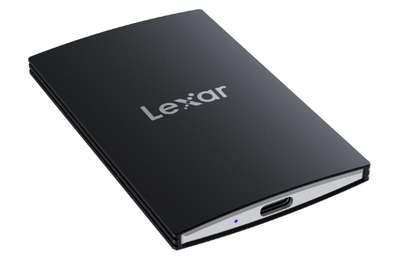
A black, rectangular Lexar SL500 portable SSD stands upright on a solid green background.
Budget pick
The metal Lexar SL500 isn’t as speedy as our top pick, but it offers solid performance and the same amount of storage.
| Capacity: | 1 TB | Physical size: | 3.3 by 2.1 by 0.3 inches |
|---|---|---|---|
| USB interface: | USB 3.2 Gen 2x2 | Warranty: | five years |
If just having the storage space is more important than getting fast transfer speeds, we recommend the Lexar SL500 (1 TB).
This is one of the speedier drives available if you don’t need USB4. Although USB4 is a must-have for people such as videographers, photographers, and gamers who deal with large files, for those who just want to back up a laptop or mail a digital shoebox’s worth of photos to a relative, the Lexar SL500 is fast enough. When we took USB4 drives out of the equation, the SL500 was faster than average compared with the 20 other drives we looked at during this testing round.
Its metal construction is durable. Since the Lexar SL500 is surrounded by metal, it will withstand the bumps of daily commuting better than a drive with a flimsy plastic body. Metal also helps cool the SSD during use, drawing performance-robbing heat away from the drive’s chips, which, optimistically speaking, should lead to fewer slowdowns and a longer life.
You can buy a magnetic kit to attach it to an iPhone. The design is not quite as svelte as the Corsair EX400U’s built-in magnetic ring, but you can purchase the SL500 with a rubbery magnetic case for a few bucks more. The magnetic sleeve lets you attach the SL500 to a recent iPhone for convenience while shooting video or backing up your phone.
Flaws but not dealbreakers
It uses a USB 3.2 Gen2x2 interface, which is supported by very few laptops and desktop PCs. During our testing, while connected to a USB4 port, the SL500 performed marginally faster than other drives with a technically slower USB 3.2 Gen2 interface, such as the SK Hynix Beetle X31 and the Kingston XS1000. If you need the speed for working on files directly on the drive and you have a Thunderbolt 4 or USB4 port on your PC or Mac, the Corsair EX400U is a better pick.
It doesn’t have a USB Type-A cable or adapter. Like our Corsair picks, the Lexar SL500 lacks a USB Type-A cable, so you’ll need to procure one if you want to regularly connect your drive to a computer that lacks spare USB-C ports.
Advertisement
Other portable SSDs worth considering

A dark gray Samsung portable SSD stands vertically on a green surface.
If you need extra storage space: The Samsung T9 (4 TB) is an alternative to our upgrade pick, especially if you don’t need the 4 TB Corsair EX400U’s MagSafe compatibility or its USB4 speed. The T9 also comes with a USB Type-A–to–Type-C cable, which could come in handy for use with older laptops, albeit at a slower transfer speed. The T9 has neither a built-in MagSafe ring nor a case with one made by Samsung, so it’s less convenient for iPhone Pro videographers. Like our budget pick, the Lexar SL500, the Samsung T9 uses the USB 3.2 Gen2x2 interface, which is just as fast as “regular” USB 3.2 Gen2 on most laptops and phones. While the EX400U is faster for working on large files on USB4-equipped laptops, the T9 is speedy enough for 24/7 backup connected to your laptop or for use as storage for a digital shoebox full of iPhone pictures.
If our picks are out of stock: Due to reduced inventory and market pressures, our top pick and upgrade pick may be unavailable online. Other portable SSDs that performed well but may lack features like UBS4 or MagSafe compatibility include the SanDisk Creator Pro Portable SSD, OWC Envoy SSD, and PNY Pro Elite V2.
What to look forward to
When we last tested portable SSDs and other storage devices in the latter half of 2025, they were cheap — around $100 for 1TB and around $300 for 4TB — and plentiful. Since then, the rise of AI and subsequent contracts to build data centers around the world have constrained GPU, RAM, and NAND memory chip supplies to the point that our picks and competitors have doubled or tripled in price, if you can even find them in stock.
We asked a Samsung public relations representative about the price increases and inventory constraints. “Rising semiconductor prices are a global challenge impacting the broader industry,” he said. “Samsung expects to be relatively well-positioned on the supply side through strategic partnerships and will continue efforts to minimize the impact on its business by responding flexibly to market changes, but some impact on price is likely given current market conditions. Samsung believes meaningful customer satisfaction comes from continued investment in innovation and experiences users genuinely value. We remain committed to advancing our products in line with this approach.”
We also asked Corsair about the out of stock situations. “With the severe supply constraints come frequent in and out-of-stock situations, we continue to ship all skus as much as possible,” they said. “The mentioned supply landscape also is causing elevated pricing that is not expected to change in the next months.”
We will monitor the situation, and we are prepared to re-evaluate our choices and recommendations in the near future. But prices have continued to trend upwards in the past four to six months at similar rates for most manufacturers. If you need extra storage, buy it; we don’t think prices will improve for the spring and this summer at least.
Advertisement
The competition
The Samsung T7 Shield (1 TB) and the Samsung T7 Shield (4 TB) were our top pick and our upgrade pick, respectively, in the previous iteration of this guide. While these drives remain solid choices, our new top pick and upgrade pick are more compact, offer extra convenience features such as built-in MagSafe compatibility, and have the faster USB4 interface.
The other USB4 drive in our latest test group was the SanDisk Extreme Pro USB4 (4 TB), which is more expensive than our upgrade pick, the 4 TB Corsair EX400U. This SanDisk drive was unable to keep up with the Corsair model when we tried randomly writing little files to the drive, barely topping out at 24 MB/s while the Corsair drive was writing over 110 MB/s; it was, however, competitive on our other tests. This SanDisk model also takes up a lot more physical space than the Corsair drive, and it lacks a MagSafe magnet.
We were intrigued by Synology’s BeeDrive in both its 1 TB and 4 TB capacities. Both are compact drives that come with a utility that can back up a USB-connected Windows PC or Mac, plus back up the photos and videos from iOS and Android phones wirelessly over your network, as long as the PC you’ve connected the drive to is also on your home network. Both drives landed squarely in the middle of the pack in speed and price. If the idea of installing and using an automatic backup utility for your laptop and phones appeals to you, the BeeDrive is worth looking into.
We evaluated other current drives but dismissed them for various reasons, including high price, worse performance, missing features, flimsier construction, or a combination of those factors. This group included the Adata SC740, Adata SD810, Adata SE880, Crucial X6, Crucial X10, Crucial X10 Pro, G-Technology G-Drive, Kingston XS2000, Lexar Rugged Armor 700, Lexar SL300, OWC Envoy Pro Elektron, OWC Envoy Pro FX (4 TB), OWC Envoy Pro Mini, Samsung Portable SSD T7, SanDisk Creator Phone SSD, SanDisk Extreme Portable SSD V2 (1 TB), SanDisk Extreme Pro Portable SSD V2, SanDisk Professional G-Drive SSD, Seagate One Touch SSD, Seagate Ultra Compact SSD, Silicon Power MX10, Silicon Power PX10, SK Hynix Beetle S31, Western Digital My Passport SSD (1 TB), and Western Digital WD Black P50 Game Drive SSD.